

I’m explaining how we got here in the first place.
How would you tell the story of America’s decline over 30 years in the gutter games of government? Give it a go. I’ll be happy to show you the courtesy so few have shown me — in 20 years of telling undeniable truth that takes both parties to task:
And being practically spit on for it.
[T]here could be no country that makes less use of the accumulated experience of those who have served it – none that is more frivolously neglectful and improvident of these assets – than the United States of America.
— George F. Kennan, Around the Cragged Hill
Sounds a lot like what I’ve been saying all along — and what Barbara Tuchman said long before that (captured by Russ Hoyle in Going to War):
Tuchman alighted on a root cause of folly that she called “wooden-headedness” — defined in part as “assessing a situation in terms of preconceived fixed notions while ignoring or rejecting contrary information.” She also saw wooden-headedness as a certain proclivity for “acting according to wish while not allowing oneself to be deflected by facts.”
Wooden-headedness, said Tuchman, was finally — “the refusal to benefit from experience.”
Ain’t that America
When I was growing up, it was inconceivable that America would become a country that tap dances around reality on a daily basis:
Delighting in contempt for correction.
A go-to tactic of the doubt-free is to make damn sure the debate never reaches the merits of the matter. I’ve seen highly intelligent people derail discussions by claiming that “everything’s just an opinion.”
Nobody really believes that — it’s just a cop-out.
And if you call ‘em on it, they fall back on Old Faithful — “agree to disagree.” How this hijacked-for-hackery ethic caught on over the years can be charted with the times:
Where things that once meant something, now mean nothing.
True folly, Tuchman found, is generally recognized as counterproductive in its own time, and not merely in hindsight. In Tuchman’s template, true folly only ensues when a clear alternative path of action was available and ruled out.
In conversation with a colleague in Europe, she spoke of a time when they told their American partners that some new system wasn’t going to work.
They ignored the advice — and when it didn’t work, they wanted reporting and analysis to prove it.
I laughed out loud — as I know the feeling, all too well. However absurd that was, at least those people wanted the proof. I have an idea that could turn the tide, but as it involves proof that puts both parties in their place, I’m persona non grata.
Never mind my idea serves them both and the nation to boot.
In a culture that wants to win at all costs, ideas for the greater good don’t compute. Your ways have repeatedly failed and will continue to do so, but why bother learning when lip service is so much easier.
“We . . . want it now, and if it makes money now, it’s a good idea. But . . . if the things we’re doing are going to mess up the future, it wasn’t a good idea. Don’t deal on the moment. Take the long-term look at things.”
— The Dust Bowl
“Dealing on the moment” is what America does “best”
And it shows!
At the core of why my efforts don’t compute — is that my mission is not driven by changing your values, but rather the manner in which you pursue them.
How can you expect anyone to admit when they’re wrong if you won’t? And every time you allow emotion to run roughshod over reason, you further calcify habits at the other end of the spectrum from these:
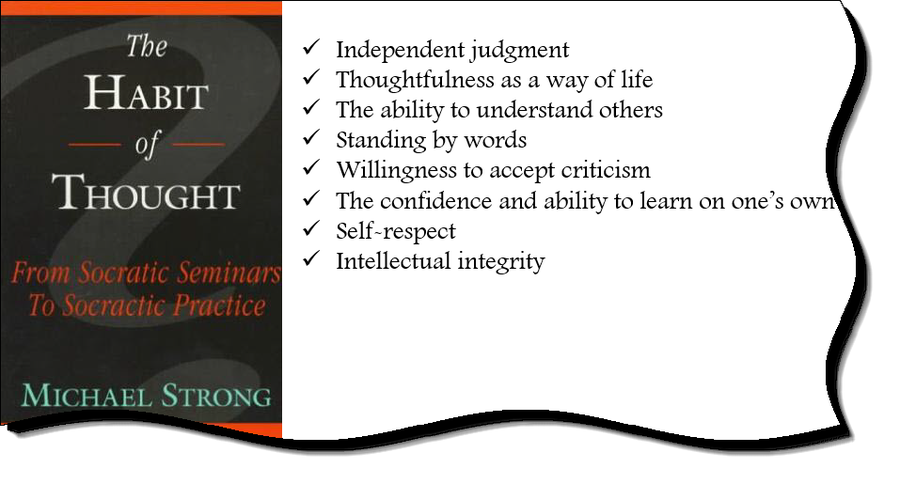
Rather than assert that all opinions are equal, students in seminar learn to judge opinions on the basis of the reasons given for those opinions.
Nobody ever had to explain that to me. I’m sure you all feel the same:
And yet here we are
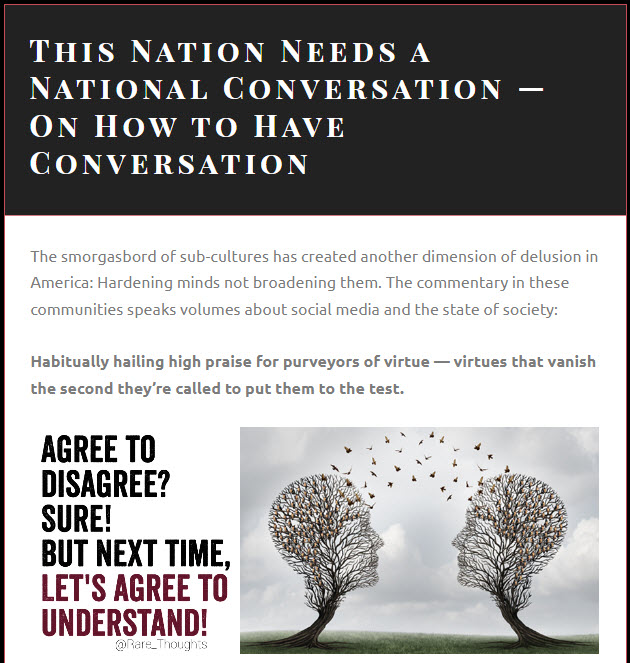
Just where should I go to find the genuine article? With all these “non-partisan” organizations pushing principles in the pursuit of problem solving, I should be welcomed with open arms.
If I weren’t challenging people on their board, I might be. But they change the rules when protecting their own.
A lot of that goin’ around


Rather than welcome a challenge to better yourselves and the country you’re so concerned about — you remain in your echo chamber of “affirmation independent of all findings” (borrowing from Peck who borrowed from Buber).
 One Voice Became Two